


SMART FACTORY SOLUTIONS CONSULTING - ELEVATING MANUFACTURING STANDARDS
The Fourth Industrial Revolution is unfolding powerfully across developed nations, offering opportunities to reshape economies, engineering, technology, healthcare, and education. In the industrial and manufacturing sectors, this evolution has formed smart factories with superior features, creating breakthroughs in production efficiency.
What is a Smart Factory?
Specifically:
- Smart Factory is a term used to describe a production environment where machinery is the primary driver in improving efficiency through factory optimization and automation.
- Regarding the Smart Factory concept: The facility is digitized and highly connected via smart production methods. This is the result of Industry 4.0.
- Smart Factory involves the integration of application software with machinery and equipment connected to the Internet. Data is aggregated and analyzed using Artificial Intelligence (AI) programming.
- Smart Factory Solutions represent a transition from traditional automation to a connected production method with continuous data processing. The ability to "learn" from production and business activities helps the system adapt to new market demands.
- Most importantly: A Smart Factory is capable of evolving and improving to suit the growth of the business, whether expanding markets, launching new products, or meeting operational and maintenance needs.
A connected smart factory cannot function without an MES (Manufacturing Execution System) to coordinate operational functions. Many features provided by MES are indispensable and cannot be easily replaced by IIoT (Industrial Internet of Things). MES integrates technologies such as augmented reality, cloud computing, AI, and Auto-ID. It is also used to analyze production KPIs and OEE (Overall Equipment Effectiveness).
Overview of the Smart Factory 4.0 Model
There are many ways to define "smart" depending on the evaluation framework. However, from a manufacturing perspective, a Smart Factory applies technological achievements to solve production issues, aiming to enhance productivity, optimize costs, reduce prices, and improve product quality.
As technology evolves, the smart factory model of each era differs accordingly.
 |
Historically, the smart factory has evolved through 4 levels of digital transformation:
1. Smart Factory in Industry 1.0
The use of mechanical tools improved production efficiency, alongside steam engines replacing human or animal power. These achievements boosted production efficiency by 4 to 8 times.
2. Smart Factory in Industry 2.0
The invention of electricity and electric motors allowed factories to apply these technologies in lighting, machine tools, production lines, and heating equipment. This created a breakthrough in production methods, leading to the emergence of mass production lines.
3. Smart Factory in Industry 3.0
The birth of semiconductor chips led to smart computers, opening the era of Information Technology. This serves as the foundation for all modern production. Computers and software applications became indispensable tools in every factory, from design and planning to production organization, data storage, and communication.
Alongside computers, the development of PLCs (Programmable Logic Controllers) and microcontrollers integrated into machinery created sophisticated automation systems, replacing humans in many stages and fields. This enhanced efficiency, quality, and the ability to create complex, high-precision products.

4. Smart Factory in the 4.0 Era
Smart Factory 4.0 - The key to Industry 4.0 - inherits the characteristics of Smart Factory 3.0 (computers, digitized data, automated machines, cameras, and sensors) but shifts production methods profoundly. While it has elevated manufacturing, some limitations remain. Traditional automated systems often handle isolated stages. Roles in supervision, maintenance, management, and inputting information still require human intervention. More modern machines mean more complex input data; delayed information can lead to large batches of defective products, resulting in significant losses.
Smart Factory Example: To plan production for a laser cutting machine, the planning department must confirm orders, inventory data, actual machine capacity, current schedules, and maintenance plans. A vast amount of information must be processed before a plan is issued. Furthermore, information like actual machine efficiency (OEE) or inventory status (goods in progress, in transit, or defective) can be difficult to control manually. This reveals current manufacturing gaps:
 |
-
Time lost in intermediate data processing -> prolonged lead times.
-
Information accuracy: Risks in production due to manual data entry.
-
Labor costs for intermediate processing stages.
-
Underutilization of machinery performance.
By applying Industry 4.0 achievements like IoT platforms, AI, and Big Data, all objects in the factory are interconnected (IoT). With modern sensors, almost all information needed to describe the system can be collected and digitized. Data from all "Things" is updated instantly to a shared system (Big Data). Data is automatically processed from input to output, ensuring continuity and adaptability in the production chain. Simultaneously, humans can gain near-total and real-time control over the entire production sequence.
Benefits of a Smart Factory:
A Smart Factory possesses distinct characteristics:
-
Proactive: Capable of meeting and adapting to strict market requirements. Humans can control machinery, monitor operations, and digitize activities to improve efficiency and handle issues promptly.
-
Agile: Businesses can actively develop their smart production systems according to market needs and expand into new markets flexibly.
-
Connected: It intelligently connects all machinery, helping businesses create a more efficient supply network.
-
Transparent: Smart data collection networks provide a solid database for more accurate decision-making.
-
Optimized: Minimizes human intervention in production systems while ensuring high efficiency.
As mentioned, a smart factory uses technology to solve production puzzles. Since each business has unique problems, the specific benefits will vary. Here are some typical examples:

1. Higher Operational Productivity
How is a smart factory more efficient? It relies on automation to complete processes, requiring less human intervention. When production depends heavily on humans, it can be stagnated by labor shortages, holidays, sick days, or safety concerns.
Machines are different; they don't need rest. They can work for hours or days. Automated machines can be programmed to run 24/7, making the process faster and more cost-effective. Instead of performing repetitive manual tasks, employees are freed to analyze data, innovate, and create high-value customer experiences.
 Packaging Automation |  Transport Automation | .jpg) Sorting Automation |  Logistics Automation |
2. Higher Customer Satisfaction
Smart production is data-driven. This data comes from various sources: customers, internal systems, and connected products. With this info, you can predict demand. You can see if a specific item is selling well and increase production in real-time. Conversely, you can scale down production of slow-moving items instantly.
You can also ensure flexibility through quick equipment reconfiguration. It can easily adapt to produce different products. When configuration is agile, you save time and money as adapting to new schedules causes less disruption. |
3. Better Product Quality Control
With smart factory solutions, manufacturers can control quality proactively. In this model, traditional QC departments might even be phased out as IoT monitors and controls the creation process in real-time.
Parameters like temperature, pressure, speed, and humidity are monitored to identify when they trend toward exceeding specifications. The system issues early warnings before products fall below standard. This helps managers pinpoint the exact time and source of the first failure, allowing for specific corrective measures.
Additionally, analytical devices monitor key production steps, ensuring components fit technical specs early on. Detecting defects early minimizes wasted machine time on faulty parts, reducing costs.
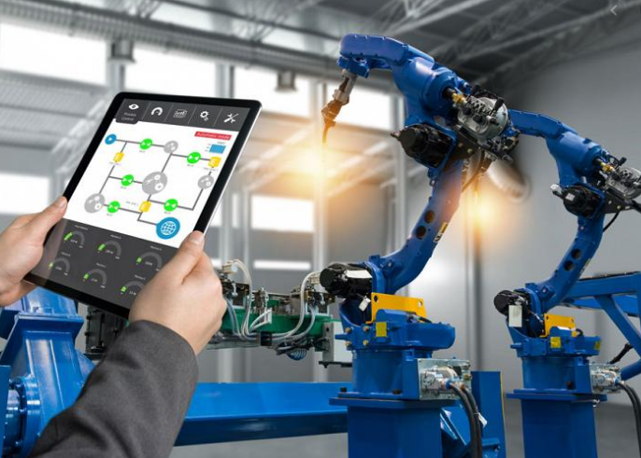 |
4. Predictive Maintenance
The smart factory model offers better status visibility, allowing manufacturers to address maintenance issues before they lead to downtime or quality problems.
Example: Sensors attached to equipment send real-time operational data and automatically generate repair schedules, allowing businesses to optimize production planning.
5. Enhanced Machine Utilization
When machines are modeled and data is collected fully, humans can easily control machine performance. By identifying factors affecting efficiency, solutions can be implemented to boost output.
Furthermore, when the entire production chain is modeled, bottlenecks become visible. Adjustments and improvements can then be made to raise not just local machine efficiency, but overall system performance.
High-Tech Factory Structure - Partial or Full Automation?
Smart factory models vary by era. Experts analyze that factories in developed regions (Europe, US, Asia) are currently at the end of Level 3 and the beginning of Level 4.0. What does the 4.0 structure look like?
 |
1. Automation and Information Digitization
The 3.0 model uses automated machines and IT applications. Sensor technology has evolved to simulate almost all object states—from simple "yes/no" or count data to advanced temperature, humidity, and camera systems that detect shapes and defects. Through these sensors, the "physical world" is described via digital signals.
